Nguyen… nghoon… nghun.
I keep seeing this word all around Vietnam: on signages, in storefronts, in the names of riders on the Grab app. You know you’re dealing with something Vietnamese the moment you come across the word—or the surname.
A quick Google/Gemini query returns two explanations. Together with actual human results, Nguyễn (I’m sorry I couldn’t be bothered with the proper diacritics until now) refers to the most popular surname in all of Vietnam. Neat. Some say it’s what “Kim” is on the Korean peninsula; doubly neat. I’ve also picked up that it originally referred to a string instrument, its original Chinese characters involving a bow; something about its gentleness or artfulness, and the playing of such, that made it distinctive to a certain clan, a certain lineage, before political history turned it into the country’s majority surname. Think of “Schumacher,” which interestingly enough literally means “shoemaker,” and all that turned it into a German surname. That’s Nguyễn. Triple-neat.
The other was Nguyên. Not the surname, but another Vietnamese word altogether, one whose existence only becomes obvious once you stop pretending the diacritics don’t matter. Google Translate glosses it as original, whole, complete, intact, unbroken. Whether that’s the best translation is almost beside the point; those were the meanings that stuck with me, and they became the lens through which I started seeing everything else around me. Since I plan to keep typing the word throughout this piece, and I still don’t know how to type in Vietnamese without breaking my flow every few sentences, this will be the first and last time I bother with the proper spelling. From here on out, we’ll stick to plain old “Nguyen.” It’s not that I don’t care about cultural or linguistic nuance, but that’s what everybody says against efficiency. We really can’t have it all. Life has trade-offs at every turn, I suppose.
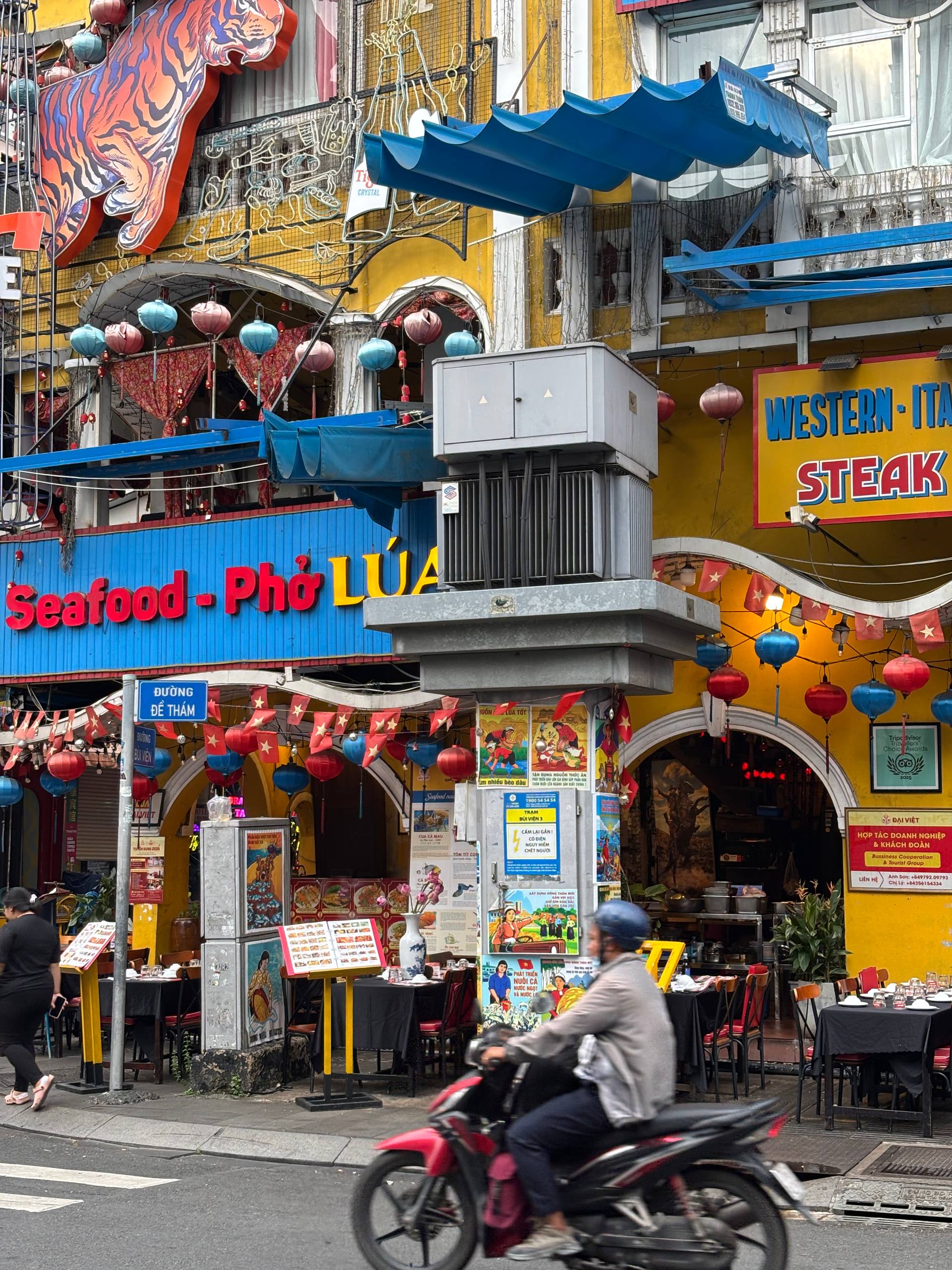
Nguyen. Unbroken. Scooters upon scooters upon scooters. There’s a lot of this in Vietnam, much like in Indonesia, the other Southeast Asian country I’ve been to, and of course the Philippines, where I live. I don’t think it says anything especially profound beyond the fact that we all have terrible traffic, and we all unanimously hate it. Yet we refuse to be fazed by it. We’ll get wherever we need to go, whenever we need to, fast—period.
Nguyen. Unbroken. Culinarily, there’s an unbroken streak of street food, almost united by the same bread, the same noodles, the same diluted sweet fish sauce. I wanted to include a particular coriander and the various mint leaves here, but mercifully for many Filipinos, not every dish comes with them by default.
Nguyen, conveying a kind of earnestness—almost religious resolve. That’s what our tour guide embodied throughout our excursion: relentlessly upbeat, relentlessly engaging, making sure everything stayed on schedule as he powered through an entire day’s work. We were taken to the war tunnels, where I caught another whiff of “Nguyen”: in the signages, and in the Viet Cong ethos of making sure the GIs don’t win—or die, nay, starve trying, by way of bamboo spikes and salvaged enemy scrap metal.
Nguyen was the streak of low-thirties Celsius throughout my stay. I might have been cocky, being a Filipino allegedly accustomed to the tropical sun. I forgot that I spend most of my days under office air conditioning, sedentary, staring at pixels—not outside, walking from one place to another, trying to absorb a culture or find my next Dasani bottle at a K-Circle.
Nguyen were the sidewalks and the bus system in their consistency, reliability, and cohesion. Suffice it to say I joined the rest of Filipinos in our familiar envy, which seems to surface after every overseas trip. We fall into the same tradition as Rizal and the so-called Ilustrados, whose entire movement was animated by returning from Europe and realizing that home, by comparison, had much catching up to do.
Nguyen. There’s an unbroken visibility to the Vietnamese flag and all its accessories: government posters, crests, on-brand banners. I imagine this must be tied to genuine affection and national solidarity. It has to be—or it risks becoming nothing more than pieces of fabric hung in public places, marking another holiday whose significance not everyone fully understands, or still believes in. On the day our own flag was supposed to be everywhere, I barely saw any in one Philippine city.
Nguyen almost sounds like nguyain (ngoo-yah-een) in Filipino, roughly meaning “to chew.” The language’s flexibility practically invites the metaphor: there’s always something to chew on before, during, and especially after travel.
Nguyain. Not the potentially off-putting fresh Vietnamese herbs in your canonical pho or banh mi on your first day in Saigon. But fine—we’ll go there. Nguyain, like chewing on wet instant noodles with beef while dipping pineapple bun into the broth at some random breakfast joint in Wan Chai. You realize you could make this exact thing back home with very little effort.
Nguyain. Maybe not the herbs, but certainly the sausage, the cold cuts, the vegetables, the mayo, the sweet chili sauce tucked inside a short French baguette. Back to Vietnam—and another realization that this, too, can be recreated at home.
Nguyain. (Yes, I’m forcing this.) To chew on the realization that for all the things we Filipinos envy about our neighbors, there are just as many things we know, deep down, that we could do ourselves—no sweat. Maybe even better. Sadly for the rest of the world, that’s one thing we can’t export, even if we tried, migrant workers notwithstanding.
And so we eventually return home through the mediocre airport we call NAIA, reflecting that—for better and for worse—there’s no place like home, especially if that home is the Philippines.
Psych!
I remember telling one of my Grab drivers—specifically one I hailed through the English-speaking category—that our cultures are more alike than they are different. And I think that’s a good thing.
For the longest time, the party line has been: What makes me special? What makes me stand out? What makes me, me? I’m all too familiar with that impulse. Self-definition is human nature. We don’t want to dissolve into one another into a featureless monolith. That’s just crazy.
But there’s a quiet beauty in discovering that the common ground is much larger than we first imagine. It makes you realize that you’re in the same boat, thinking many of the same thoughts, feeling many of the same things—that neither side is especially magical, nor a cultural specimen waiting to be admired as a novelty by passing tourists.
As I went through my literal paces—eating on low-rise stools with the locals, waiting for the ice to dilute a strong cà phê beneath the sun—I found myself thinking that there may not be a singular, gnostic “Vietnamese experience” after all, at least not one any more special than the “Filipino experience,” or the “Indonesian experience,” despite what YouTube might have us believe.
Traveling through a few countries has already dissolved much of my assumption that geography or culture grants people access to some exclusive way of seeing the world. Certainly the language differs, and linguistics has plenty to say about that. Certainly there are differences in expectations, customs, and social dynamics. But every single time I walk out of a local restaurant, have a drink with someone, or chat with a street vendor, I leave with exactly the same feeling: that I’ve just spoken to another perfectly ordinary human being.
I suppose that’s the real reason I travel.
Many people find profundity in the novelty of displacement, and then try to preserve that feeling once they return home. What makes displacement profound to me, though, is almost the opposite: the quiet, sublime realization that wherever I go, I remain—for all intents and purposes—a human being on planet Earth, surrounded by other human beings on planet Earth.