“Gemini, what is Tribo-core?”
Gemini doesn’t know, because it hasn’t been coined yet. I made it up, and this is a post explaining what it is, why I felt the need to make one, and subsequently the need to “launch” it in this manner.
Tribo-core is my bid to add to the many “-core” subcultures populating the world right now. Much like Hindu deities, they spring up just as often as they need to. Cottagecore, the subculture that likes cabins, flowers, and ethereal elements, reminding you of a cross between Alice in Wonderland and the world of the hobbits from Lord of the Rings—or something to that effect, I don’t know. Check! I’m not going to enumerate examples here, because I’m probably that socially oblivious, or I don’t care that much about labels.
I’ve practically stopped caring about them the moment I heard the “-core” affix being donned outside musical contexts. That’s nice, but I’m not sure I could keep up with it. I, and the rest of the music world, started with “hardcore” from hardcore punk. It’s like punk but more… screamy and chaotic, I guess. I listen to it; I love it. Then we get metalcore, probably the first affixation of “core” to a root word. It’s the fusion of classical metal songwriting elements with the rhythmic chaos and rustic angst of hardcore—or something like that. This got pushed way to the edges, from my perspective, when we got easycore: your vanilla pop-punk, but with breakdowns in the major scale.
Binondo-core is a kind of kitsch aesthetic marked by Chinese characters, a red-blue duotone palette, and blockprint, linocut-style illustrations, from the nostalgic “Good Morning” towel, which I assume mostly came from Binondo, or the lunar calendar donning the same color scheme, which I also assume mostly came from Binondo.
Back to music: hope-core, which was what I saw people describing the music of Flawedmangoes as, as it played in the background over some incoherent, psychedelic rambling that’s supposed to be motivational. Yet musically, it sounds more like a mix of math rock and shoegaze, if I’m not mistaken.
A quick search on Google (yes, not AI!) quickly yielded this website called “Aesthetics Wiki,” a wiki that, truest to netizen form, becomes a subculture of its own by attempting to catalog all subcultures through the “look and feel” that represent them. Dreamcore? Check! Webcore? Check! Femboy? Okay, you get the point.
So let’s do this: tribo-core. I dub this as a qualified outsider, much like the heathens in Antioch dubbing Christians, short of the pejorative underpinnings. There is no spite carried through in this initiative. I just like naming things because efficiency is a great thing in a life full of complications. My reasons for it, however, wouldn’t be as simplistic as this initiative might suggest. It all goes way back to before I was born.
Nationalism is not a bad thing in the Philippines, not in the same sense it seems to be used in the US. For one, a Filipino “national identity” is inherently pluralistic. Up until the Spanish conquests, there was no “Philippines”; there were just islands, and cooperating (sometimes fighting) tribes, cross-trading, sometimes among themselves, sometimes with groups from outside the island chain. Think Chinese, Indians, Indonesians, Malaysians, and what have you. Long story short: you go through years of trade and consequent cultural exchange as the default, and cultural plurality becomes the default. So Filipino nationalism is, in the grand scheme of things, benign, if not refreshing from a humanities standpoint: no racial exceptionalism; heck, no imperialism—absolutely none.
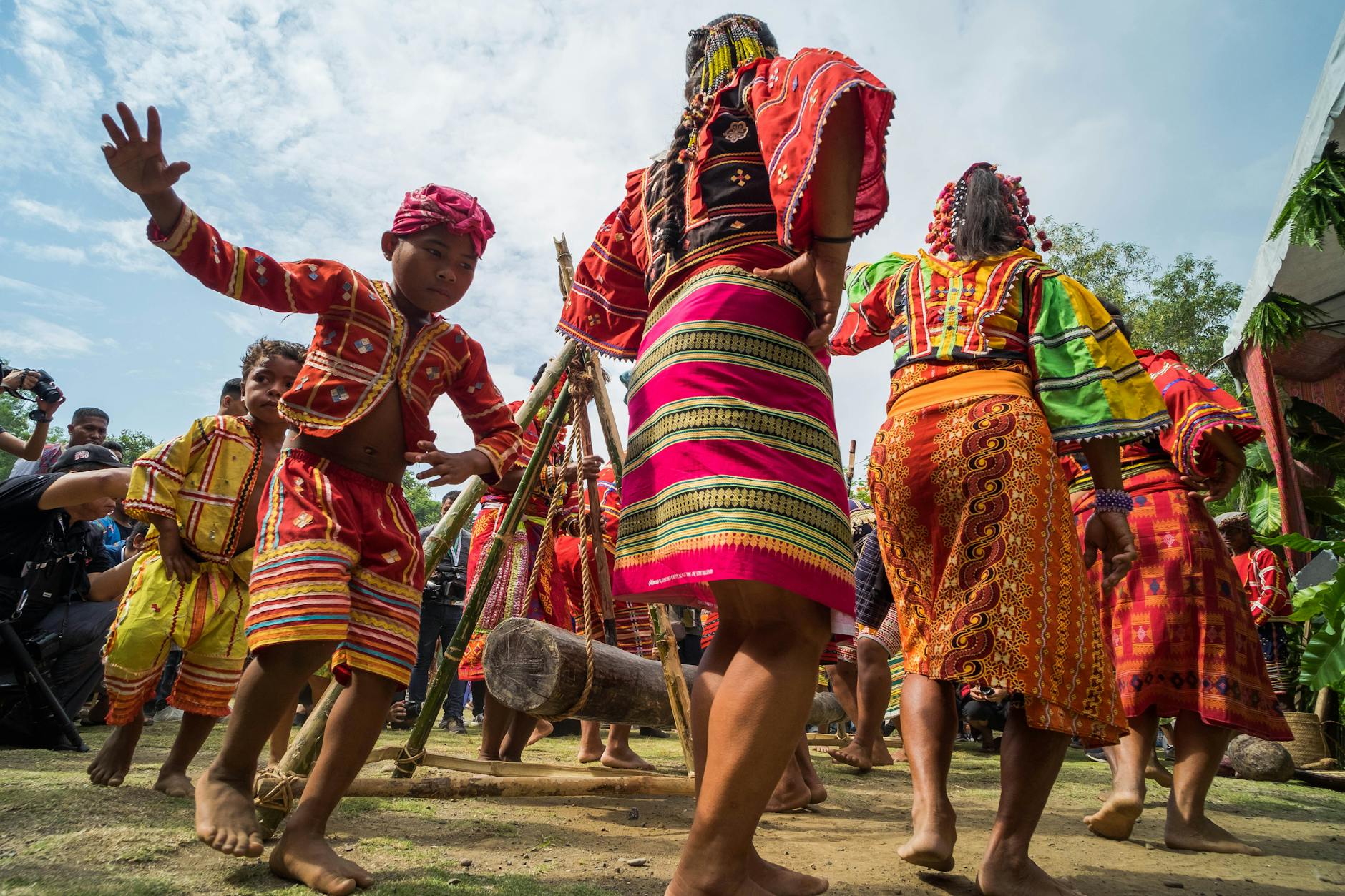
Yet it always seemed to me that there’s been this narrational undertone of pinning the Filipino identity not to this dynamic cultural pluralism, but to an ethnic common denominator—what has been implied throughout our history and civics classes as the pre-colonial zeitgeist. And the indigenous tribal norm that characterizes it is where “tribo-core” comes from. Think handwoven fabric, brass instruments, bamboo weapons, primitive art forms, non-democratic/conservative political structures, and, more significantly, an ancient syllabic writing system called Baybayin, which, if you try learning it, will remind you of Hiragana but with Hindi-looking characters—you can’t get any more Austronesian than that! Think ritual music, animistic deities, more ritual dances, artisanal mining and jewelry, and a collection of indigenous folklore. That, and more: this must be, to many people, the original Filipinos.
And through my journey as a creative, you tend to come across people who amplify these sentiments as part of the convention. As a common person, it’s easy enough to understand the appeal of Baybayin, why people dip their toes into trying to learn it (it’s surprisingly easy to pick up), and why some people even have it tattooed on themselves. But probing further may lead you to ponder why many people think that a distinctive writing system may be the key to significance and increased value for a country that has been desperate for recognition. I mean, look at Japanese characters—they’re cool. Many of us don’t have to understand what in the world they actually mean, but we know they’re Japanese, and we’d love to have them printed on our clothes and whatnot. Or what about Thai? Why do they get to keep their own writing system while ours got replaced by bland, twiggy “white people” letters? (No offense to Latin typographers.)
And why stop there? Why should we wear white-people fabric? Use white-people fixtures? Build white-people buildings? As a brother to a heritage conservationist and tropical architecture researcher, I’ve witnessed the adamancy of my sister from the ringside. It had to be possible to live in the Philippines without air-conditioning, through design no more clever than what indigenous people had already figured out thousands of years ago with their huts. The idea flies in a few substantial ways. This doesn’t seem to be some shallow type of romanticization; it somehow goes deep.
I see tribo-core as part of a broader umbrella of what we have now come to know as “decolonization”: shave off most Western, European influences, and you’ve got yourself a somewhat pure form of whatever we’re looking at. That’s nice, that’s noble, that’s fascinating.
Now all that is from the inside, looking out. But I write today as someone from the outside, peeking back in. I had worked as an intern for a legacy publishing company: Christian at its core, with significant intersections with environmentalism and what I have now decided to call tribo-core. I suppose most of it comes from its long history publishing “cultural redemptionist” minister Ed Lapiz of Day By Day. A profiled graduate of studies in Filipino anthropology, it’s not that hard to see why the megachurch’s “DNA” is tribo-core almost through and through. No Hillsong here; instead, original songs in Filipino, maybe Western in arrangement and structure, but categorically indigenous in the choice of instruments—and dance steps, with traditional wear and all. The weekly celebrations run on what people may call a “Filipinized” liturgy. Those initiated, such as myself, will remember its “Pistang Kristiano” (Christian Festival), an annual de-Romanized (and evangelicalized) amalgam of traditional Filipino festivals. Where there was an absence of saintly figurines, the appearance of the “higantes” (lit. giants) made up for it. Those are core childhood memories. It also helped that its peak coincided with the Philippine Independence Centennial celebrations. But that’s not what ultimately led me to take a look back at this party, part of the underlying impetus of a long-running curiosity as it may be.
At the end of it, I felt like it finally needed a name, with the discourse itself concerning the concept of identity. Utilitarian! For example, instead of calling this booth I saw at an art fair “the booth that sells graphic novels featuring tribal people,” I can now just call it the tribo-core booth. This is an actual thing, by the way, but I continue to hesitate naming names here because I don’t want to sound like a cold, detached analyst over something that’s meant to be personal, meaningful, and fun. But the distance I’ve had from it is far enough for me to be more cognizant of the distinctness of finally engaging with such material.
I don’t even read graphic novels, and this might surprise many. Some people thought, through my sheer demeanor perhaps, that I was someone who played chess, drove a car, knew how to play cards, or had a lot to talk about when it came to computer games. I’m none of that. But I am, for all intents and purposes, a creative—an artist. How this happened to become a fundamental part of my life is for another day, but this is where I find myself. Although, in fact, had it not been for adjacent people more initiated into independent merch culture, I wouldn’t have found myself on occasional pilgrimages to these affairs. If it wasn’t for them, I wouldn’t have expanded my enthusiasm for independent, original, counter-corporate, DIY cultures outside of music and into the world of stickers, zines, stuffed toys, and other “consumer products.”
It had only been a matter of time before I came across familiar faces, which may be amusing given my already limited network. And there they were, taking me back to my days as a curious publishing-house intern, on lunch break, perusing the first editions of an imprint that would later on be represented by what I saw: a pretty long table, books spread out, now with tabletop card games and a few more titles in the catalog. They’ve been, as you would have it, friends, even if it took some time for reminders.
We exchanged not a few words as a consequence. And as someone who’s unusually always held out for more artistically resonant purchases, I hadn’t been on the lookout for sticker packs, postcards, not even art prints. And although the totes and T-shirts were compelling, the length of this writing might tell you of my inclination for something denser, more substantial, more linear—books, or anything with multiple pages in it. I’d had two in mind at the time, but it all came down to what felt more artisanal, more “indie,” if I’m not trying to be too pretentious; something that felt more intimately made. And between a commercially backed young-adult webcomic series already at its third (or fourth) volume, and a hundred or two (or three?) pages of hand-drawn, hand-painted, eccentric-feeling, niche, first-edition graphic novel made by old friends, the choice was easy, in spite of the 100% premium over the former.
I threw my card in. “Take my money.” I don’t know what it’s exactly about, having only asked about the “general idea” of it, and the moment was too auspicious for me to even care. These are friends, and I’m going home with something special from them.
A couple of weeks later, having retrieved it from my significant other after leaving it at their place because I’m me, I opened the pages. Inadvertently straining the perfect binding, page turn after page turn, I found myself smack dab in the middle of a bizarre world of extramural language, sparsely code-switching with my imperial, mongrel, impure, 21st-century metropolitan tongue. The read was as frictioned as the page turns on a brand-new book. Washed pigments over rustic inking, depicting brown skin, gold jewelry, vessels; scenes of what seemed to be Chinese and Indian people trading with citizens of the fabled tribal states of old.
There was a baby… someone who had just been born… but he was different. Could he be the protagonist? Am I reading about a prophecy being fulfilled? There seems to be a setup, like a conflict is brewing beneath the barter trade of gold—which is what I take the whole thing to be about, given the title of it, written in a native language, printed in gold foil stamp against a matte black cover. Nice. Better keep reading. I wouldn’t wanna miss the payoff! Okay, next page—snap!
The leaves tore away from the stitches.
And maybe that’s the whole point — that feeling of being severed from something. From what we might have been, as a “nation,” had the white-people dominion not clocked in for its 500-odd years. My friends seem to think so, anyway. (The Japanese are technically pale too, someone will point out. Yellowish, fine. I concede.)
I wired a message to the humble publishing house’s hotline. They said they’d be willing to fix it for me for free. And I guess this is the essence of tribo-core, their “deal”: to piece back together an idea of the Philippines if things had been better, and if the white people had just chosen to be helpful friends rather than the repulsive, greedy, deluded conquistadors that they had been (and perhaps still are in some way). Because the proposition is that there’s a huge chance we could’ve ended up way differently, perhaps way better than how we’ve come to be today had that been the case—that, and we’d get to write with cool letterforms just like the others… and not get stuck with the bland, twiggy, white-people letters.