I book weeks in advance. Everybody knows the place—it’s where you go when you want an escape, something that feels, in very specific and sometimes overstated ways, different from the lowlands (which, in most conversations, just means Metro Manila). “Main Characters,” as one might endearingly call them—whom, from my understanding, refers to the demographic that comes to vibe—and then spend a few more minutes than I would ever bother trying to frame that perfect background: pine trees, but not just pine trees—pine trees with the right kind of light, sharp and dramatic, early morning, probably in John Hay, or somewhere that looks enough like it that, to me, it may as well be the same place.
I couldn’t really tell the difference between most places in Baguio—period.
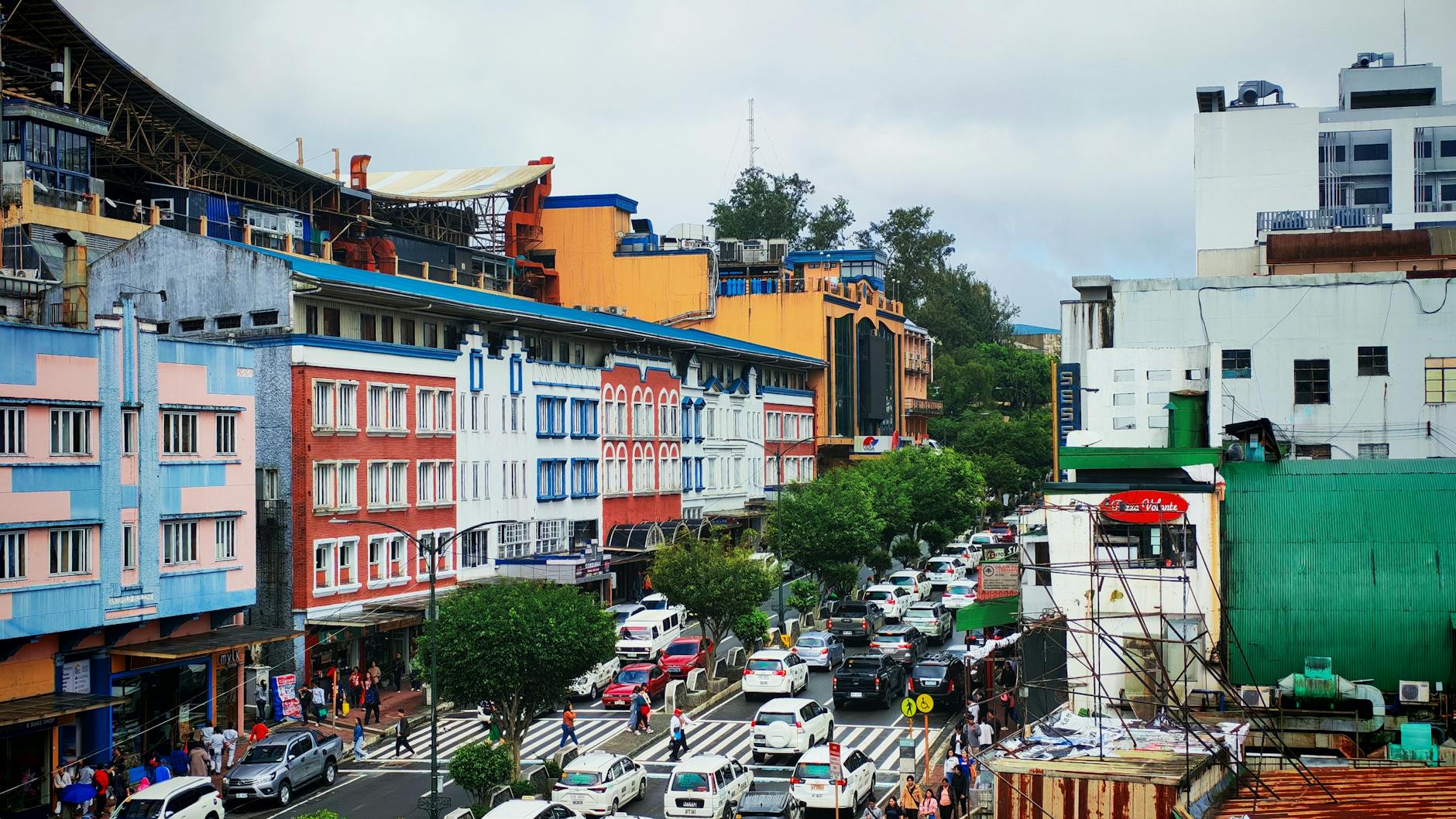
Of course, you have the icons. The distinct open roof of SM Baguio, hovering a few slopey kilometers away from Burnham. Burnham itself—with the lake, at the moment, out of service, in the process of trying to look better—being the sort-of centerpiece that it is. Session Road, Porta Vaga, the cathedral a few hundred steps up. That now-iconic bridge in front of BGH—the one people first see coming in from Marcos Highway. Mines View, Botanical Garden, The Mansion, Camp John Hay.
And then, after that—it’s pine trees. It’s clouds painting the horizon, sometimes below you. It’s mounds and layers of establishments rising above them in ways that feel both organic and slightly accidental. White taxis everywhere—noticeably faster than their Metro Manila counterparts, which I’ve come to assume is less about recklessness and more about torque, momentum, and the practical realities of navigating steep slopes after even steeper slopes. Or you take the jeepney and realize that, aside from being a bit more colorful or elaborately decorated, they don’t quite come the same way they do in Manila: less frequent, more defined stops—and when you try to hail one along the way, it’s already been filled up back at the terminal. There’s less passenger-fishing here.
I usually do day trips to see my significant other. Long-reason-short is schedule alignment—and love. Sometimes I stay longer, but most times I don’t. I leave at 7 a.m., for the same said reason, and anybody who’s done this enough times will, almost in unison, correctly guess that I touchdown at around 12… or 1:30—depending on the season.
I am a Victory Liner guy. I love Victory Liner. I will shill for Victory Liner. Why not. Online booking? Check. Multiple bus types across multiple price points? Check. Some of the—if not the—coolest bus terminals in the country? Also check. And when you’re headed to Baguio, you arrive through one of them.
Pine trees—inside the station. Fake, obviously, but that still gets a shiny gold star from me. That’s on top of what is, in my opinion, a pretty well-done interior. You can argue for the nostalgic, slightly “rustic” charm of the Governor Pack terminals, but I’ve decided I’m sticking with Team Utility Road. Besides, you get lunch at Jollikod: The Home of the Famous Crispy Dinakdakan. I usually end up getting papaitan—still warm, in a way that suggests I’m late to it, the heat having already gone with the drivers and the early birds, some of whom are probably a loose collective of influencers getting their clips for whatever they’re reviewing this week.
There’s your Jollibee. There’s your 7-Eleven. And then your first few hundred steps toward what is, functionally, the indispensable urban basecamp: the all-seeing, all-knowing, omnipresent SM Baguio.
For your first few times in the city, there’s that moment—the distinct pine tree smell, carried by the cold, humid breeze. You notice it immediately. You stop, even if you don’t realize you’ve stopped. You inhale, exhale, and in that very small, almost scripted way, you acknowledge: yes, you’ve made it. You are not in some toasty, smoky, urban lowland, and you’re not even inside an air-conditioned mall—you are, perhaps for the sake of your obligatory selfie, officially in Baguio.
And then, somewhere around your twentieth-something trip, that’s the first thing that starts to go.
The smell disappears. Or maybe you just stop noticing it.
I’ve tried to compensate for that. I’ve brought a film camera, sat by the window, tried to look for something—anything—that might spark something in me, something that would justify staying awake through the five-hour trip while my legs slowly go numb. These days, the strategy is different. It’s an inflatable neck pillow, a decent sleeping mask, a face mask, mouth tape, and either Loop Earplugs Experience 2 or the Moondrop Space Travel with ANC on, depending on my mood—and then one pill of melatonin to seal the deal. You set it up, close your eyes, and wake up miles above sea level. Rinse and repeat.
You also learn things. Small things, mostly. Like the “special” drop-off points—the ones before the terminal, for the native and the savvy. I usually get off at an earlier segment nearby what is, by far, the best-value single-person accommodation you can book online in Baguio—as far as I, and what seems to be an increasing number of quietly observant tourists, have come to realize.
It may be useful to note that you can, in fact, take the escalators in Porta Vaga up to the cathedral and skip the Pilgrim Stairs entirely. The internet seems very intent on making sure people know this. I’m Baptist, and I’ve already had my outrageously priced 50-peso strawberry taho there—and a few more times elsewhere—so I feel like I’ve done my part. Special mention to the one in John Hay, with the slightly bitter caramel drizzle. I have notes.
And on the way through Porta Vaga, you might find yourself at PVM Canteen. A plain carinderia, the kind you’d find at almost every turn in Metro Manila—but you go anyway, because at this point, immersion is the point. And there, if you’re paying attention, you might experience something interesting: segregation. Queue segregation. You’re a mall customer, not a tenant.
Last weekend, I would’ve spent time in person with my significant other for a little less than eighty full days in Baguio, cumulatively—give or take. I go back soon. And, God-willing, again after that. And again.
And for many, upon arrival, it will be as Baguio as it can possibly be. They will, truest to form and by convention, catch the vibe—maybe even try to be the vibe, to be one with the pine trees, to fill their lungs with that 18-degree late-night breeze, and whatever else comes with that.
I don’t forget: this is Baguio.
And for me, it will be Baguio too—but in a way that has become, over time, very specific. I get off at the usual stop. I rehydrate—first of all—at the only carinderia in the area, the one whose meat dishes I perpetually find hard to give any sort of respect; always lean and always very mean to my gums. I go around town, on foot, see what I might need. And then I go to her, and proceed—as per usual.
Much later, when the time comes, I make my way back home. Reluctantly, and a little begrudgingly, obligated to catch the last trip. Passing once again through those synthetic pine trees—for a very particular reason.
And with that same reason, not long after, I find myself casually making my way back up again.