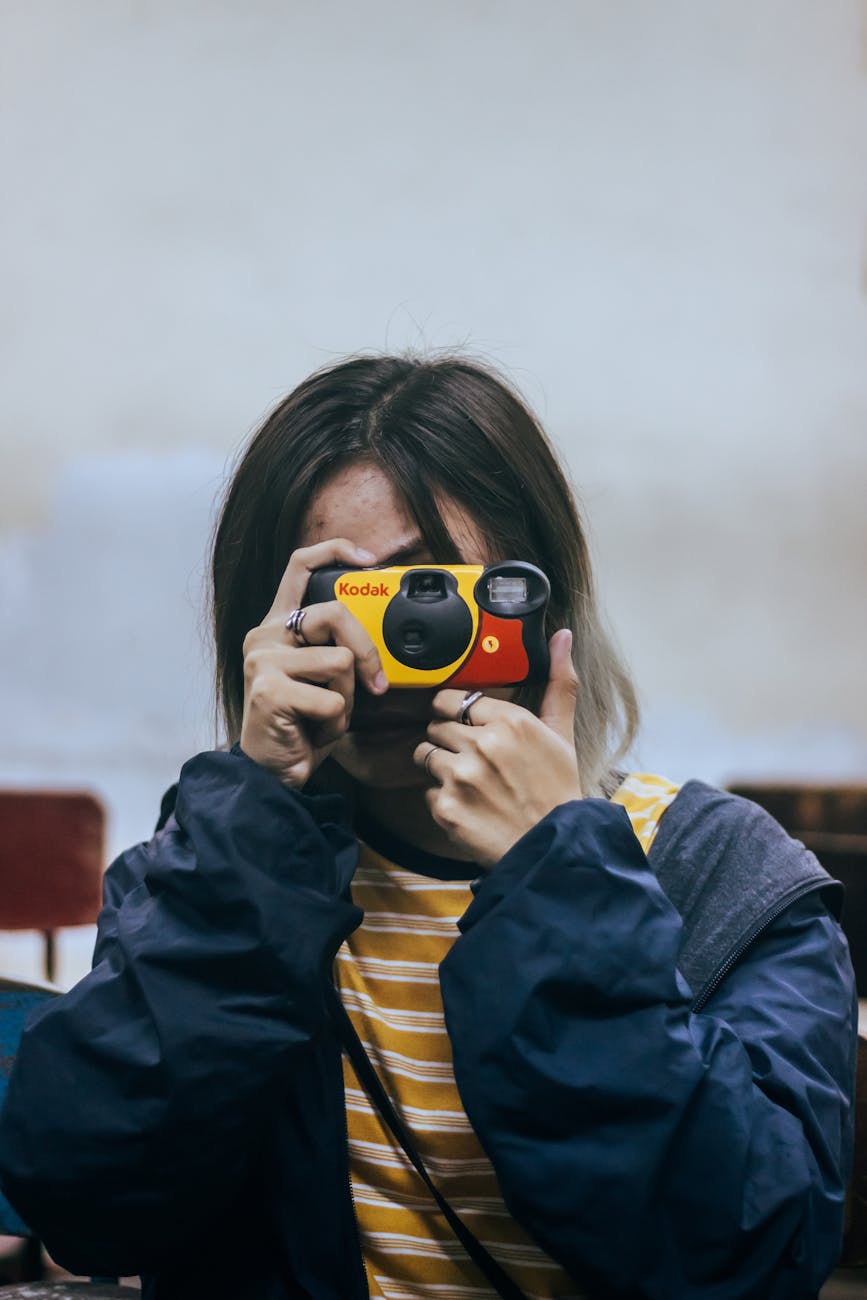
Of all the places to rediscover a childhood fascination, Tokyo Disneyland wasn’t exactly where I expected it to happen. It was near the end of our eight-day trip through Japan, and I was wandering through souvenir shops with half-hearted intent. I’m not much of a souvenir guy, but amid the usual trinkets, something caught my eye: an Utsurundesu, what the rest of the non-Japanese-speaking world knows as the QuickSnap 400, a disposable camera.
The sight of it transported me back twenty-five years to a school field trip at Enchanted Kingdom, our own Filipino Disneyland. I remember seeing one of those old Kodak disposables in someone’s hands, and even then I was fascinated. I’d always been curious about cameras, especially film ones, but the adults around me understandably wouldn’t trust a kid with something so delicate and costly. Film was expensive, and “playing” with it wasn’t worth the risk. So I watched from the sidelines, curiosity intact but unfulfilled.
Until that day in Tokyo Disneyland, when I finally gave myself permission to pick one up.
Learning to See Again
I wouldn’t call myself a photographer. I’m just a person who likes to do cool things, and taking pictures happens to be one of them. I’ve always lived on both ends of the artistic conversation, so almost by nature I’m drawn to photography, even if only in a casual, explorative, self-fulfilling way.
The Utsurundesu became my teacher. I had to relearn the basics: when to use the flash, what ISO 400 actually meant, why I had to roll the film after every shot. I had to accept the limitations of a disposable lens and remind myself that this thing doesn’t work like a phone. Ironically, my phone had already taught me a valuable lesson: I needed to keep a steadier hand, since this camera had no stabilization to save me.
I knew the theory—exposures, apertures, the general rhythm of light—but this was my first real step back into the kind of medium where it all began.
The Thrill of Not Knowing
It’s not a phone. And that’s kind of the point. Shooting film means thinking about the shot before you take it. You only get a handful of exposures, and you have no idea what they look like until the film’s developed. That alone changes everything.
There was a brief onset of anxiety, but I learned to embrace it the same way one embraces a rollercoaster. You’re in it for the thrill. There’s something about committing to a moment without the safety net of instant review and deletion. It’s risky, vulnerable, and oddly freeing.
It also felt like a full-circle moment—finally engaging a huge part of my 90s childhood that I’d missed, now with all the means to enjoy it properly.
Even now, as I write this, I haven’t seen the developed photos yet. What surprised me most was how faint the shutter feels—barely a click. I caught myself second-guessing if anything even happened. But that subtlety is part of the ritual. Mistakes, uncertainty, and rawness are all built into the experience. You learn to welcome them.
Pre-Thinking, Not Overthinking
Once the anxiety faded, film became a practice in being conscious and intentional. Constraints, I realized, enhance creativity. With only a few exposures and a fixed lens, aperture, and shutter speed, you want every frame to count. Yet at the same time, you don’t have to obsess over settings; you just have to understand the camera’s limits and play within them.
I know the Lomography school says not to overthink things, and I get that. But I’d say I “pre-think” them. I anticipate. That probably breaks the “rules” for disposable cameras, but film stock isn’t cheap. And that limitation adds to the thrill.
Film reinforced something I already did with digital: think before I shoot. When in doubt, I lift the camera, frame the shot, and decide if it’s worth taking. I don’t just snap everything in sight. Somehow, I already know the kind of pictures I want to make, and that clarity feels good.
Lines, Light, and Urban Energy
I’m drawn to lines and light, what some would call urban photography. It’s the environment I live in, familiar and alive, a curated showcase of energy and rhythm. Nature photography has its place, but compositionally it’s harder for me to connect with its randomness. I don’t visit those places often enough anyway.
The city, though—that’s where the light performs. Concrete and neon, shadow and symmetry. Recently, it’s also stirred an interest in candid portraits, though I don’t yet have the gear for it. Maybe one day, even with film.
Shooting with film already comes with its own aesthetic, that “film vibe” everyone tries to mimic digitally. But there’s a story in it that pixels can’t quite replicate. You can feel when something’s been captured by photons hitting silver emulsion instead of a sensor.
I hope my photos come out human, honest, and humble.
They mirror my personality more than I intend. I shoot what catches my interest, sometimes simply for the sake of the snapshot. I might not care much for sunsets, but the gradient of color and light, that split horizon—those small details probably say more about me than I realize.
My process is mostly instinctive at first, then deliberate. Instinct helps me spot the subject; deliberateness helps me frame what I’m trying to say.
Glory for Glory
God hasn’t taught me anything too specific through this new fixation, but it sits within a larger calling: to enjoy His gifts, especially when He’s given the time and means to do so.
Sure, smartphones outperform an Utsurundesu in every measurable way. But what does it say about us if we measure everything by what we lose? That’s not a biblical posture, especially in light of Ecclesiastes.
It’s like the woman with the alabaster jar. Cracking it open to anoint Jesus’ feet wasn’t practical, but it was beautiful. And maybe that’s what this is too—doing something small, even inefficient, in the name of delighting in the Lord’s generosity.
God is a giver of joy. He’s pleased to let us find wonder in the tangible—in light, film, and time itself. Every snap, every photon that lands on that thin strip of silver, is a whisper of His glory reflected back to Him.
And I praise Him for that.
By the way I now have a Kodak Ektar H35 loaded with Ultramax 400. Here we go.