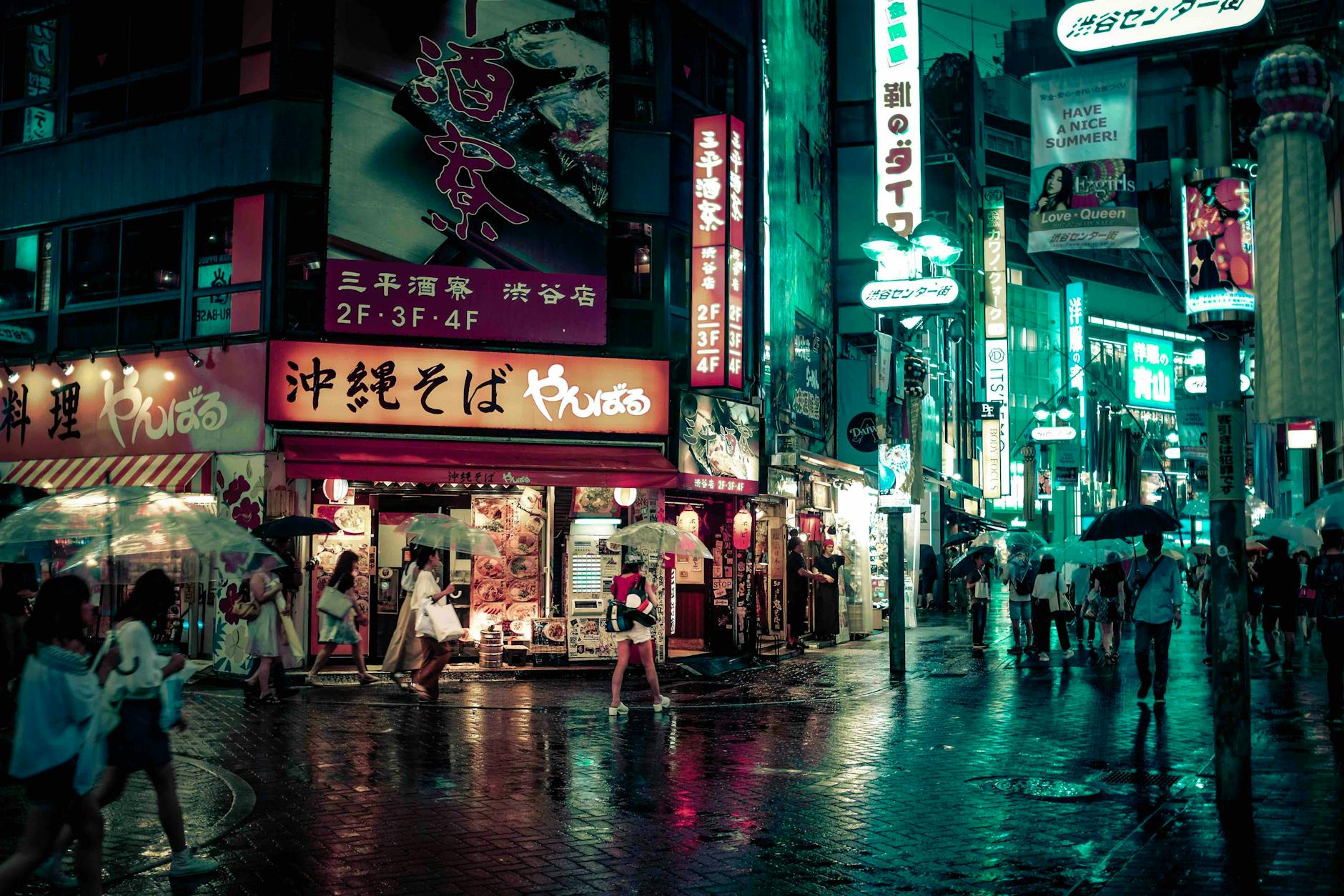
It was never about the anime. I’d only watched a few. What drew me in was the novelty: the different writing system, the surreal mix of influences that somehow became their own thing. It felt like stepping into an alternate reality. I like that feeling in general.
There was, admittedly, that early fascination with Japanese femininity, as most young men in the world note, but that wasn’t it either. It wasn’t the ramen or the izakayas. It was the strangeness that still felt familiar, something I could somehow take on.
Japan’s appeal was never one thing. It was the organized chaos of it all. I never dreamt of crossing Shibuya, but I was fascinated by the subway system—how precise, imaginative, and deeply cultural it was. The home of Yakult and Sony held a strange charm: humble and world-shaping at the same time.
For a while I got into J-rock, even before the “girl metal” wave. The Japanese have a way of turning contrasts into coherence: imaginative yet exacting, expressive yet restrained, extravagant yet minimal. They make much of things while stripping them to their bare essence.
Even as a kid, their art struck me as deeply emotive. 1 Liter of Tears lingered with me for weeks. There was something about their ability to let beauty ache.
But more than that, I admired their self-possession. They weren’t afraid to be themselves in a globalizing world. They absorbed influence but made it unmistakably theirs. A McDonald’s in Tokyo is still McDonald’s, yet not quite—the same structure, but rewritten in Japanese. I resonated with that: open to influence, but still authentic. They dance with time without losing themselves in it.
Over time, though, the illusions thinned. I began to see the limits of my understanding. The Japanese are just as human as everyone else. “Don’t meet your heroes,” they say—not because they’ll fail you, but because they’ll reveal how much of them you invented. Beneath the novelty and brilliance was something ordinary: salarymen, overwork, depression. A perfection that felt, in the end, too perfect—clean and efficient, but for its own sake. Beauty without rest. Precision without peace.
Eventually, the fascination diffused. Maybe I grew out of it. I tried keeping it alive by connecting with fans and learning a bit of Nihongo, but it faded. The relationship that partly fueled it ended, and so did that chapter. Japan stopped being a cultural mecca and became instead a mirror, reflecting both the brilliance and the barrenness of human creativity.
That’s when I began to see that beauty and culture are continuums that find their true end only in Christ. Japan, for all its brilliance, doesn’t take that final step. Beauty without Christ becomes incomplete: a loop of creation feeding creation without resolution. It burns bright, then burns out.
Now my posture toward Japan is quieter. I still see its beauty as a gift from God, but what gives it weight is knowing that a nation can stand as a beacon of greatness—so near to Him, yet miss Him entirely. Christianity remains a minority there, and that absence shapes everything. A culture indifferent to Christ isn’t neutral; it inevitably builds itself around something else. And however noble that “something else” seems, it becomes an idol.
I don’t say that in contempt. It’s not superiority; it’s grief. Because without Christ, even beauty turns inward. It becomes self-sustaining idolatry: glorious, efficient, otherworldly, and hollow.
That truth became real when I visited a small church in Tokyo. I’d only checked online to make sure the teaching was sound. The service was simple, almost fragile. Afterward, I learned how few workers they had and how deeply they prayed for help. Their burden was heavy but full of faith. And I, standing among them, felt my own helplessness. What could I do? I was just passing through.
What can a transient Filipino Christian tourist do for his Japanese brothers and sisters asking for help in a culture built on gospel-incompatible ground? Maybe, at least, share their story and bring awareness to the broader Christian community.
The Lord is strong, and I know He has great plans. And He does this through people. But Japan is easy to skip in missions because it looks fine from the outside. It’s better optics to minister to materially downtrodden regions; it fits the humanitarian model. But we’re not Marxists. We’re Christians.
Marxism measures need by material lack; Christianity measures it by spiritual death. The Marxist lens says, “Help those without bread.” The Christian lens says, “Help those without Christ.” The first stops at compassion; the second moves toward redemption. And that’s the difference.
Yes, Japan is prosperous. Yes, it’s beautiful. But its wealth and order do not make it whole. Beneath the excellence lies a deep absence — the kind only the gospel can fill. Japan doesn’t need more progress; it needs more Jesus.
Of course Japan is beautiful. But its Christians know of a far greater Beauty — the One to whom all these beauties point, and the One Japan desperately needs to know.